
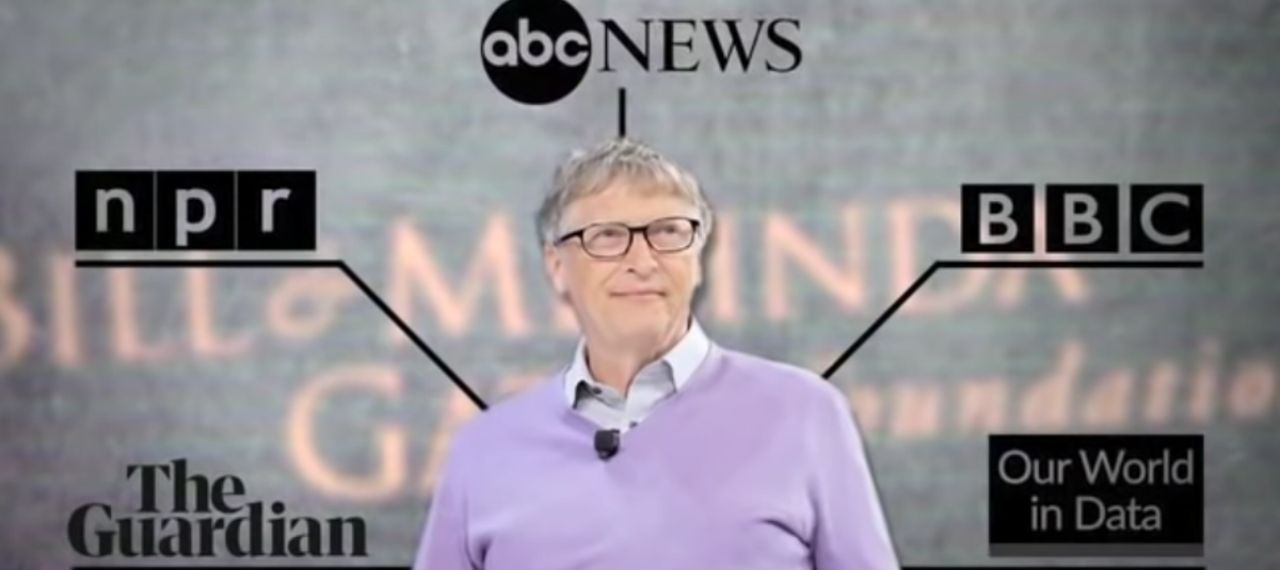
For fifteen years, Bill Gates bought the most expensive silence in the history of philanthropy. In 2026, a subpoena did what $319 million couldn’t stop.
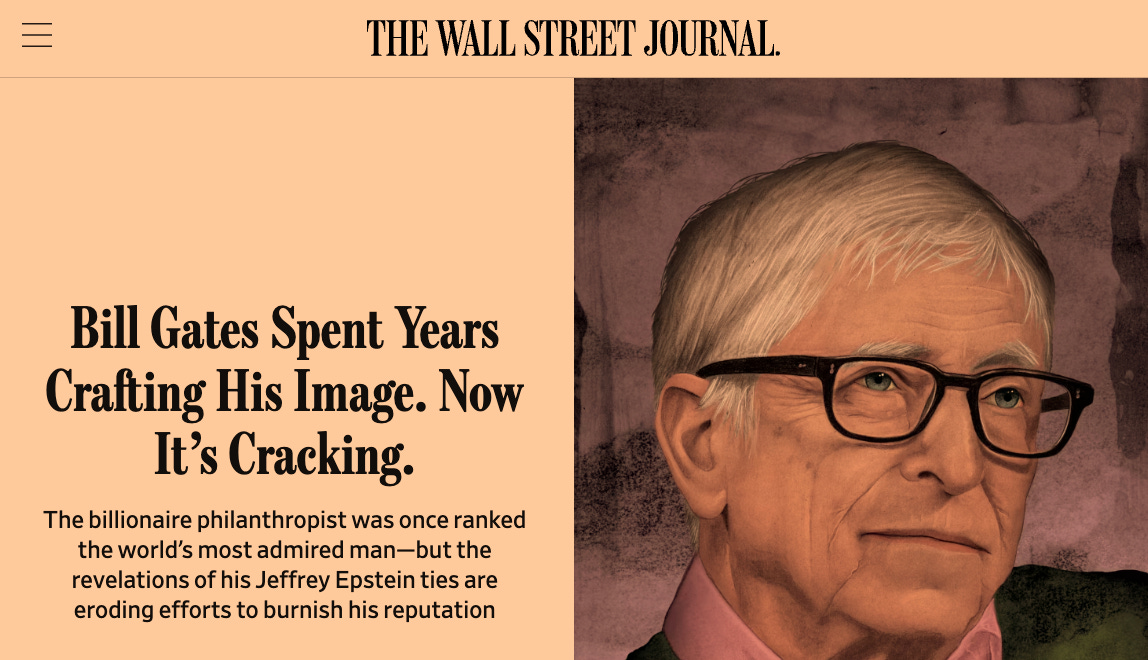
There is a custom-sized mannequin somewhere in the Gates communications apparatus. Its job was to wear Bill Gates’s clothes before he did — to let a styling team test which neutral crew-neck sweater, which pair of off-brand “Carbon” glasses from a boutique optician, would best project the image of a harmless, brilliant, world-saving nerd. Three outfits, presented to senior staff for approval, for each public appearance. The goal, according to current and former employees who spoke to The Wall Street Journal, was to make a man worth a hundred billion dollars look “reminiscent of Mister Rogers.”
That detail is genuinely revealing, and it is everywhere this week. But it is not the story.
The story is that the mannequin worked — for fifteen years. The story is how it worked, what it cost, and the precise moment this spring when it stopped working. Because the wardrobe was the smallest, cheapest part of a reputation-management operation that ran into the hundreds of millions of dollars and reached into the budgets of the very newsrooms we rely on to hold the powerful accountable. And what finally cracked it was not better journalism. It was a congressional subpoena — the one instrument Bill Gates could not write a check to redirect.

The machine
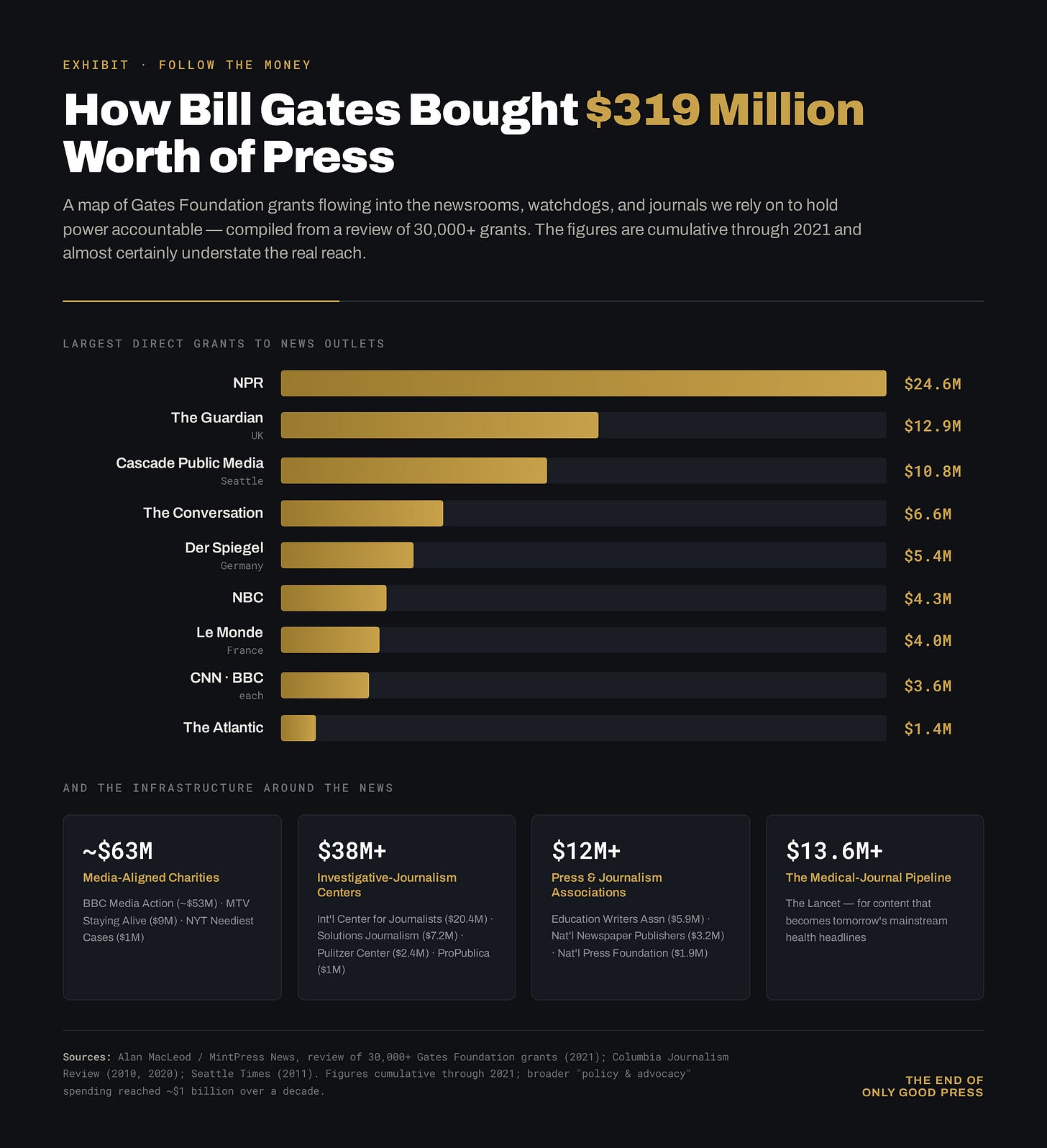
Start with the number, because the number is the story: at least $319 million.
That is the documented sum the Bill & Melinda Gates Foundation has channeled into news outlets, journalism-training programs, investigative centers, and press associations — a figure assembled by journalist Alan MacLeod, who reviewed more than 30,000 individual Gates Foundation grants for MintPress News. It is not a fringe finding. The Columbia Journalism Review reached the same conclusion a decade earlier, and Gates’s own hometown paper, the Seattle Times, reported back in 2011 that the foundation had devoted roughly $1 billion to “policy and advocacy” — about a tenth of its annual spending — much of which the paper described bluntly as “essentially public relations.”
Look at who took the money. NPR: $24.6 million. The Guardian: $12.9 million. The BBC: $3.6 million directly, plus nearly $53 million to its charitable arm, BBC Media Action. NBC, CNN, Le Monde, Der Spiegel, El País, Al Jazeera, The Atlantic. The investigative outfits we hold up as watchdogs — ProPublica, the Pulitzer Center, the Bureau of Investigative Journalism — each took Gates money too. So did The Lancet, the medical journal whose findings become tomorrow’s health headlines: at least $13.6 million for content.
Here is what that architecture purchased. Not flattery — absence. As CJR documented, Gates funding “appears to have altered the Guardian’s coverage” and “closed off large expanses of storyline,” specifically the storyline that mattered most: critical scrutiny of the Gates Foundation itself. When a single donor underwrites the global-health desk, the development desk, the journalist-training pipeline, and the press association your editor belongs to, you do not need to be told what not to write. The incentive structure tells you. MacLeod put it precisely: the institutions “we rely on to hold accountable one of the richest and most powerful men in the planet’s history are quietly being funded by him.”
For fifteen years, that was the deal. And it is why, in a 2019 YouGov poll, Bill Gates was ranked the single most admired man on Earth — ahead of the Dalai Lama, ahead of the Pope.
The crack
A reputation built on purchased silence has one fatal vulnerability: it depends on the story originating inside a newsroom. Control the newsrooms, control the story.
But you cannot buy a subpoena.
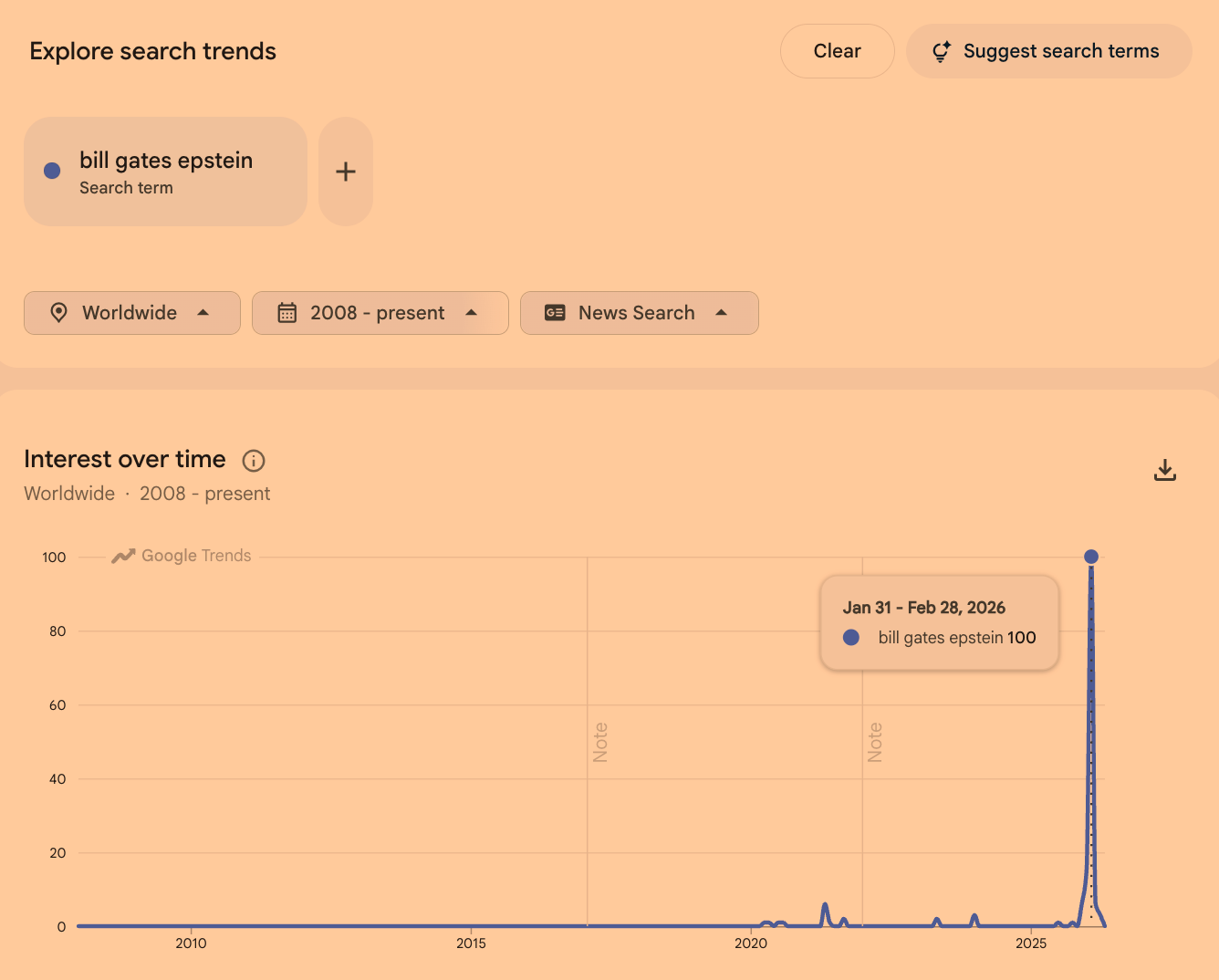
In late 2025, the House Oversight Committee subpoenaed Jeffrey Epstein’s estate. In January 2026, the Justice Department — acting under the Epstein Files Transparency Act — released roughly 3.5 million pages of documents, emails, flight logs, and images. None of it ran through a Gates-funded editor. None of it could be softened by a grsant relationship. For the first time in fifteen years, the most consequential story about Bill Gates was being written by a branch of government that he does not fund.
The effect was immediate and visible — and the most telling evidence comes from the outlets he paid. Consider NPR, recipient of $24.6 million in Gates money. In February, on NPR's Wild Card with Rachel Martin, the host sat across from Melinda French Gates and said, on the air: "I have to acknowledge the elephant in the room at this moment. Your ex-husband, Bill, is named in the newest tranche of Epstein files. And there are new alleged details about his past behavior." The funded outlet, naming him, to his former wife's face.
It did not stop there. The Wall Street Journal ran the image-machine exposé that launched this week’s cycle. And Fortune documented something far harder than any wardrobe anecdote: that Jeffrey Epstein personally emailed the wiring instructions for a $5 million Gates Foundation grant to the International Peace Institute, a U.N.-affiliated think tank, in 2013 — part of more than $8.5 million the foundation sent that institution between 2013 and 2020, with Epstein acting as a conduit.
"Bill Gates' fall shatters the myth of the benevolent billionaire and strips American capitalism of its moral cover."
June 10
Which brings us to the date that matters.
On June 10, 2026, Bill Gates is scheduled to sit for a transcribed interview before the House Oversight Committee. He is slotted into a bipartisan investigation between Epstein’s former assistant Lesley Groff and the private-equity billionaire Leon Black. Chairman James Comer has confirmed the schedule publicly; the transcripts will be released; and as Comer has repeatedly noted, lying to Congress is a felony. (I’m tracking each development in The Epstein Files Investigation.)
This is a venue with no firewall. There is no editorial-independence clause to invoke, no grant to renew, no spokesperson to stand between Gates and the question. The same machine that for fifteen years guaranteed “only good press for Bill” has no jurisdiction in a congressional interview room.
Gates’s team has a defense ready, and it is worth naming so it can be dismissed. They will argue that any reduction in the foundation’s media and advocacy spending reflects the planned 2045 sunset — the spend-down of the endowment, not a loss of grip on the narrative. But the break was never about dollars. The break is qualitative, and it is undeniable: the outlets he funded are now running the story he paid them to avoid, and his own foundation has commissioned an external review of his “engagement with Epstein.” Institutions do not audit their own founder when image control is working.
What changed
For fifteen years, the most admired man on Earth was a manufactured product — engineered down to the sweater, propped up in part by a $319 million web of media funding that left the press structurally disinclined to scrutinize him. The product held because the story stayed inside the system the money controlled.
In 2026, the story escaped. It moved from the newsroom to the subpoena, from the editor’s desk to the committee transcript, from a venue Bill Gates funds to one he must simply answer. The mannequin can still pick the outfit. It cannot pick the questions.
On June 10, for the first time, Bill Gates will face a room he didn’t buy.
This piece relies on documented public records and primary reporting. Where the underlying evidence is disputed — such as draft emails of contested authorship in the Epstein files — those claims have been deliberately excluded. The argument here rests only on what is verifiable: the grant record, the on-the-record congressional schedule, and the published reporting of the very outlets that received Gates funding.